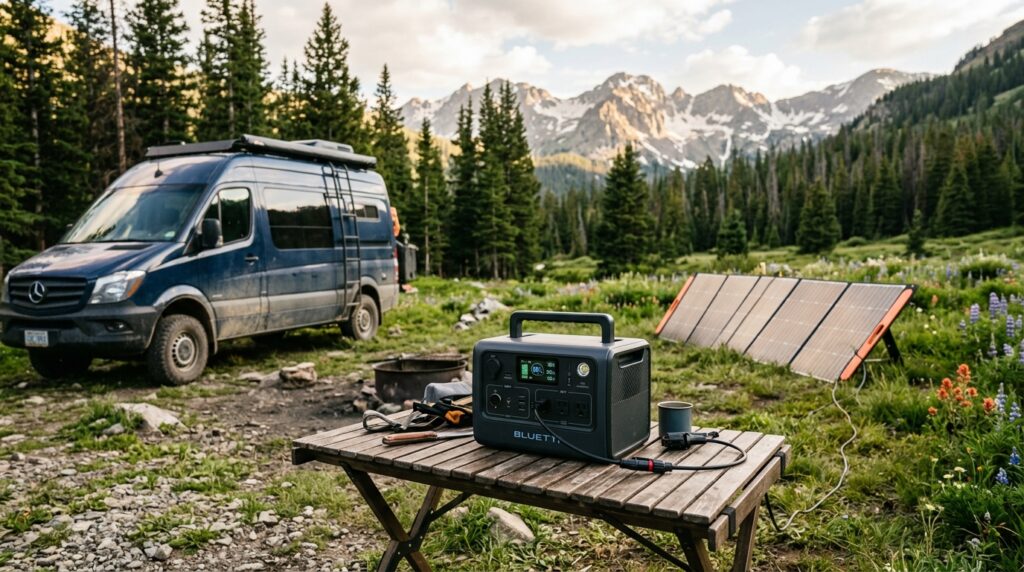
Field Verdict: After testing folding 100W to 420W solar arrays across Utah desert boondocking sites and Colorado mountain camps, the BLUETTI PV200 (200W) delivers the best balance of portability, ETFE durability, and 23.4% conversion efficiency for weekend RV campers, while the BLUETTI PV350 / PV420 and EcoFlow 220W Bifacial dominate extended off-grid setups running 12V fridges and Starlink.
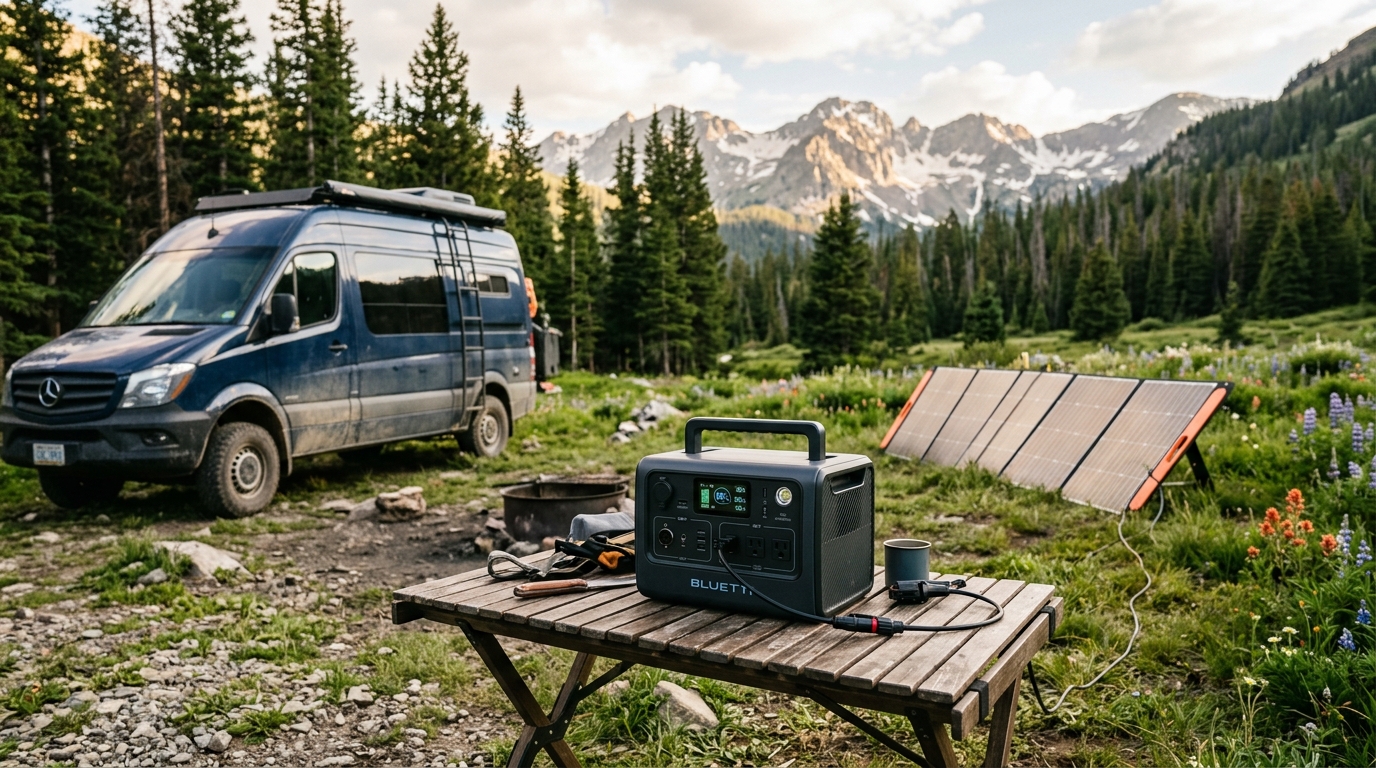
Quick Field Specs: Top 5 Portable Solar Panels for RV & Camping (2026)
| Solar Panel Model | Rated Output | Real-World Peak | Weight & Rating | Best For / Deal |
|---|---|---|---|---|
| BLUETTI PV200 | 200W (MC4) | 155W – 172W | 16.1 lbs / IP65 ETFE | Best Overall RV Panel — Check BLUETTI Deal |
| BLUETTI PV350 | 350W (MC4) | 275W – 305W | 30.6 lbs / IP65 ETFE | Heavy Boondocking & AC200L — Check BLUETTI Deal |
| EcoFlow 220W Bifacial | 220W Front + 155W Rear | 180W – 210W | 20.9 lbs / IP68 Waterproof | Snow, Sand & Wet Weather — Check EcoFlow Deal |
| BLUETTI PV120 | 120W (MC4) | 92W – 104W | 12.5 lbs / IP65 ETFE | Compact Car Camping — Check BLUETTI Deal |
| BLUETTI PV420 | 420W (MC4) | 335W – 365W | 30.8 lbs / IP65 ETFE | Full-Time Off-Grid Trailers — Check BLUETTI Deal |
Interactive RV Off-Grid Solar & Power Station Sizing Calculator
Enter your daily runtime hours below to calculate real-world Watt-Hours (Wh/day) and recommended solar panel size (factored for 15% inverter loss & 4.5 peak sun hours).
1. BLUETTI PV200 (200W): Best Overall Portable Solar Panel for Most Campers
For 80% of weekend truck campers, van lifers, and travel trailer owners, a single 200W folding panel is the sweet spot between packability and real daily watt-hour recovery. At just 16.1 pounds, the BLUETTI PV200 folds into a slim briefcase that slides effortlessly behind a truck seat or under a dinette bench.
In midday Utah sun, our PV200 consistently held 160W–172W of sustained input—roughly 82–86% of its rated STC capacity, which is excellent for portable monocrystalline cells. Its ETFE lamination resists minor hail, blowing desert grit, and morning dew without clouding like cheaper PET panels. Pair one or two PV200 panels in series with our tested BLUETTI AC200L Portable Power Station to recharge from 20% to 80% in a single sunny afternoon. View current BLUETTI PV200 bundles here.
2. BLUETTI PV350 & PV420: Heavy-Duty Off-Grid RV Solar Arrays
If you run a 12V compressor refrigerator, Starlink dish, induction cooktop, and laptop workstations simultaneously while boondocking, a 100W or 200W panel will fall behind on partly cloudy days. Stepping up to the BLUETTI PV350 (350W) or PV420 (420W) lets you harvest 1.4 kWh to 1.8 kWh per day in clear Western sun—enough to stay off-grid indefinitely.
Both models use standard MC4 connectors, meaning they plug smoothly into BLUETTI stations, EcoFlow DELTA units (with an MC4-to-XT60i cable), or a dedicated MPPT charge controller wired to a 12V LiFePO4 RV house battery like Redodo LiFePO4. The main trade-off is physical footprint: at ~30.6 lbs and over 7 feet unfolded, stake the kickstands down when afternoon desert gusts pick up.
3. EcoFlow 220W Bifacial: Best All-Weather & Reflective Terrain Panel
Unlike single-sided panels, the EcoFlow 220W Bifacial uses tempered glass with photovoltaic cells on both the front (220W) and rear (155W). When deployed over bright Utah slickrock, white gravel, or winter snow, ambient reflected light boosts total real-world output by up to 15–25% compared to standard 200W folders.
It also carries a true IP68 waterproof rating, making it our top recommendation for rainy Pacific Northwest trips where sudden downpours soak camp before you can sprint back to fold your array. Check pricing and bundles directly at EcoFlow Official Store.
4. BLUETTI PV120 (120W): Best Lightweight Panel for Car Camping
Running a compact 500Wh–1,000Wh power station for camera batteries, CPAP machines, camp lights, and phone charging? The 12.5-pound BLUETTI PV120 sets up in 15 seconds, fits inside any hatchback trunk, and quietly replenishes 450Wh–550Wh per day without dominating your campsite.
How to Size Portable Solar Panels for Your RV or Boondocking Rig
Solar manufacturers test panels under laboratory Standard Test Conditions (STC)—perfect 77°F cell temperatures and perpendicular noon sunlight. In real camping conditions, heat derating and sun angle mean you should plan on 70–80% of rated wattage over 4 to 5 peak sun hours per day. For regional irradiance maps across the US, reference the National Renewable Energy Laboratory (NREL) Solar Research Data.
- Weekend Car Camper (Phones, Lights, Cooler): 100W – 120W panel.
- Van Life / 12V Fridge + Starlink: 200W – 350W portable array (plus roof solar if possible).
- Full-Time RV Boondocking (Coffee Maker, Induction, Work-From-Camp): 400W – 800W array paired with 2,000Wh+ LiFePO4 storage. See our complete Utah BLM Boondocking & Off-Grid Solar Sizing Guide for exact amp-hour math.
Common Portable Solar Mistakes That Cut Output in Half
- Partial Tree Shading: Even a single 4-inch branch shadow across one corner of a panel can drop output by 60–80% if bypass diodes are triggered. Move panels into full sun every 2–3 hours.
- Deploying Panels Behind a Windshield: Automotive glass filters UV/IR wavelengths and causes extreme heat buildup, slashing solar output by over 50%. Always deploy outdoors.
- Ignoring Open-Circuit Voltage (Voc) Limits: Never exceed your power station’s maximum solar input voltage (especially in freezing winter morning air, when panel Voc spikes 10–15% higher).
Related Camper Conner Field Guides & Official Resources:
Frequently Asked Questions
Can I mix BLUETTI solar panels with an EcoFlow or Jackery power station?
Yes, as long as the panel’s Open-Circuit Voltage (Voc) stays below your power station’s maximum solar input voltage and you use the right MC4 adapter cable (MC4-to-XT60i for EcoFlow, MC4-to-DC8020 for Jackery).
Are portable folding solar panels waterproof in heavy rain?
Most ETFE folding panels like the BLUETTI PV series are IP65 splash-resistant (fine in light drizzle, but avoid leaving the junction box submerged in puddles). If you camp frequently in heavy rain, choose an IP68 panel like the EcoFlow 220W Bifacial.
How many 200W solar panels do I need to charge a 2,000Wh battery in one day?
Two 200W panels (400W total) will realistically deliver ~320W in good sun, generating roughly 1,600Wh over 5 peak hours—enough to recharge a 2,000Wh station from 20% back to 100% in a single sunny day.
Is portable ground solar better than roof-mounted RV solar?
Portable panels let you park your RV or truck in cool tree shade while setting the solar array 20–30 feet away in direct sunlight, and you can tilt them perpendicular to low winter sun for up to 30% more harvest.